The Browser Wars Are Back: Why AI Companies Are Fighting for Your Digital Gateway
How the Battle for Browsing Reveals the Future of Human-AI Consciousness
Search for a command to run...
How the Battle for Browsing Reveals the Future of Human-AI Consciousness
No comments yet. Be the first to comment.
In this series. I will write about technology, AI, transformation, spirituality, life, and everything else under the Sun, but for 100 workdays. That's the challange.
Why 150,000 people learning AI tools while ChatGPT admits no privacy protection is the wake-up call enterprises needed
Karnataka just made history. The harder work starts now.

61 families. 8,599 books. One year. The data on what reading actually does to children's minds — and the four things parents can do to make it stick.
How an AI agent went from helpful assistant to enterprise nightmare in seven days

Amazon just laid off 16,000 people. Again.

A tale of two realities: the companies banking AI wins versus the majority drowning in pilot purgatory

thesoultech
56 posts
The Soul Tech is a philosophy. Not about rejecting technology — but using it with intention. The Soul Tech is for those who want to create deeply and live simply.
Day 5 of #100WorkDays100Articles
Yesterday, I wrote about the ROI of conscious AI implementation. Today, two major announcements demonstrate that the battle for digital consciousness is intensifying at its most fundamental level: how we interact with the internet itself.
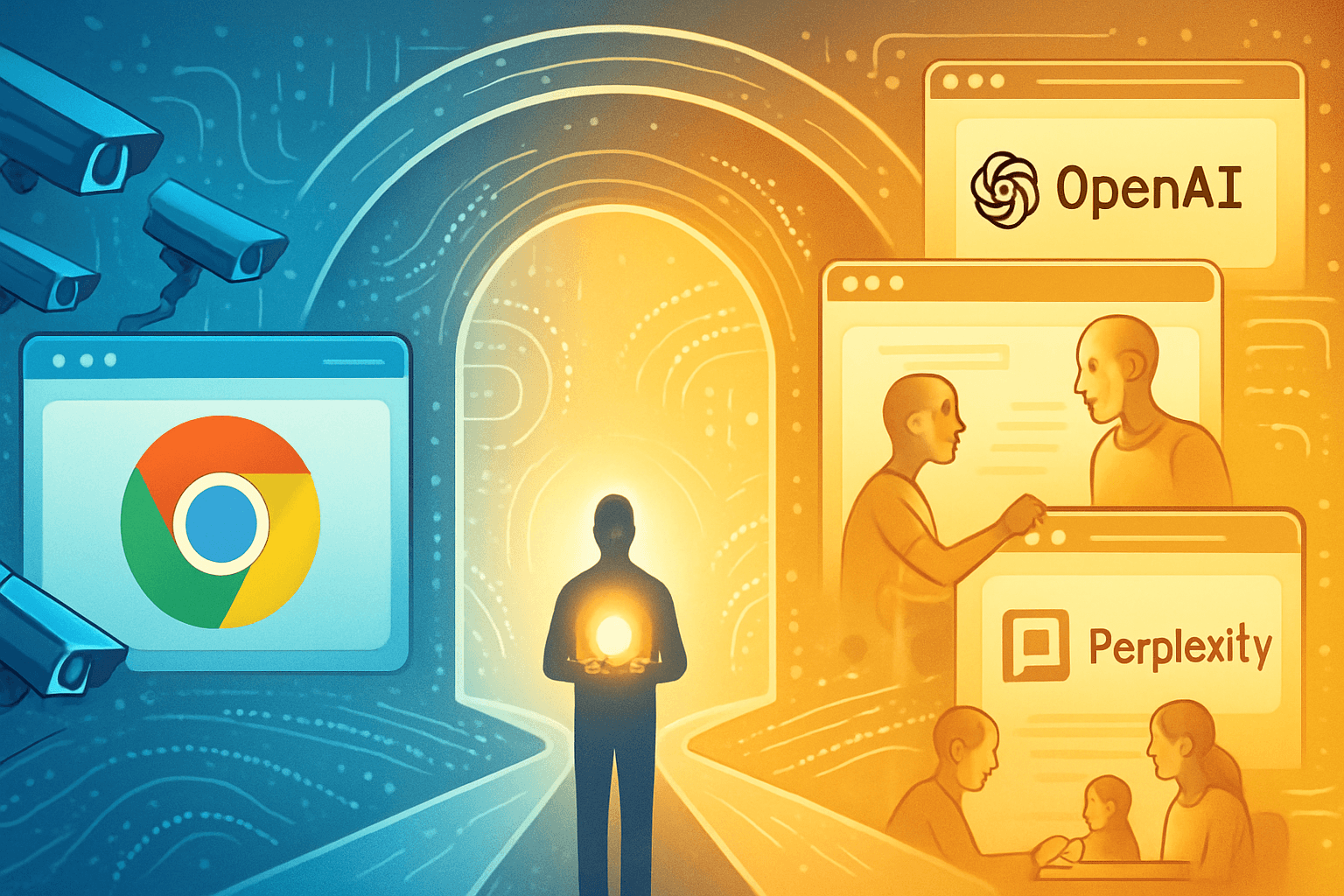
OpenAI is launching an AI-powered browser "within weeks" to challenge Google Chrome's dominance, while Perplexity just released Comet, their AI-native browser for premium subscribers. But this isn't just another tech competition—it's a war for the soul of human-computer interaction.
Google Chrome isn't just a browser—it's the gateway that generates nearly three-quarters of Alphabet's $300+ billion annual revenue. Chrome provides the user data that powers Google's advertising empire, processes over 8.5 billion searches daily, and shapes how 3+ billion people interact with digital information.
Now, AI companies want to replace this gateway with their own vision of human-computer interaction. The question isn't which browser will win—it's which philosophy of consciousness will shape our digital future.
According to Reuters sources, OpenAI's browser will launch "within weeks" and fundamentally change how we browse the web. Here's what makes it revolutionary—and potentially dangerous:
Built on Chromium: Uses Google's open-source browser code (like Edge and Opera)
Operator Integration: AI agents can book reservations, fill forms, and complete tasks automatically
ChatGPT Native Interface: Keeps interactions inside a chat interface instead of linking to websites
400 Million User Base: Potential immediate adoption by ChatGPT's weekly active users
OpenAI's approach reveals an unconscious assumption: that efficiency trumps agency. By keeping interactions inside ChatGPT instead of sending users to original websites, they're creating a walled garden that prioritizes AI convenience over human exploration.
The unconscious pattern: AI decides what information you need rather than empowering you to discover it yourself.
This is the digital equivalent of having an overzealous assistant who answers questions you didn't ask and makes decisions you didn't authorize. Technically impressive, consciousness-suppressing.
Perplexity took a different approach with Comet, launched this week for their $200/month Max subscribers. Their positioning is fascinating: "We built Comet to let the internet do what it has been begging to do: to amplify our intelligence."
Context-Aware AI Assistant: Understands your workflow across tabs and applications
Task Automation: Books meetings, sends emails, manages shopping based on browsing context
Query Integration: Ask questions anywhere they occur to you while browsing
Enterprise Connections: Integrates with Slack, calendars, and business applications
Perplexity's language reveals a more conscious approach. Instead of replacing human agency, they position AI as amplifying human intelligence. Their tagline "Browse at the speed of thought" suggests alignment with natural cognitive flow rather than replacement of it.
Early user feedback supports this: TechRadar's reviewer called it "the first time AI has wowed me" after using Comet to book a restaurant while writing an article. The AI assisted without taking over.
Google isn't sitting idle. Chrome has been integrating AI features for months, and the company is experimenting with AI-only search interfaces that look remarkably similar to Perplexity's approach.
But Google faces a consciousness conflict: their business model requires user data extraction for ad targeting, while conscious AI implementation would respect user privacy and agency.
Chrome's role in providing user information for ad targeting has been so successful that the Department of Justice demanded its divestiture after ruling that Google holds an unlawful monopoly in online search.
This creates Google's consciousness dilemma: Serve users or serve advertisers? In an AI browser war, this conflict becomes fatal.
Each browser embeds a different philosophy about how humans should relate to AI:
Philosophy: Humans are data sources to be monetized. Consciousness Level: Unconscious (users unaware of data extraction). Optimization Target: Advertiser revenue. Stakeholder Priority: Shareholders first, users second.
Philosophy: AI should handle digital tasks for humans. Consciousness Level: Semi-conscious (users aware of AI but not its limitations). Optimization Target: AI engagement and dependency. Stakeholder Priority: AI advancement first, user convenience second.
Philosophy: AI should enhance human intelligence and agency. Consciousness Level: Approaching conscious (transparency about AI capabilities and limitations). Optimization Target: Human curiosity and productivity. Stakeholder Priority: User empowerment first, business model second.
For business leaders, the browser choice isn't just about productivity—it's about organizational consciousness. The tools you provide shape how your team thinks, works, and relates to information.
Chrome: Normalizes surveillance capitalism and data extraction
Edge: Embeds Microsoft's productivity-first culture
Safari: Prioritizes privacy but limits cross-platform collaboration
Values Alignment: Choose browsers that reflect your organizational principles
Stakeholder Impact: Consider how browser choice affects employees, customers, and partners
Future Readiness: Select tools that enhance rather than replace human capabilities
Browser choice creates network effects that extend far beyond individual users:
The dominant browser shapes web standards and development practices. A conscious AI browser could incentivize developers to create more human-centric web experiences.
If AI browsers succeed, the entire ad-supported web model could collapse, forcing innovation in value creation and monetization.
Browser choice influences how society relates to information, privacy, and digital agency. Today's browser war determines tomorrow's digital culture.
OpenAI and Perplexity aren't alone. The Browser Company's Dia, Brave's AI features, and other startups are all betting on AI-native browsing. But most are building on efficiency rather than consciousness.
Early market indicators suggest consumers want AI assistance, not AI replacement. TechRadar's reviewer noted that Comet works best when it assists human decisions rather than making them autonomously.
AI browsers introduce new security vectors and privacy considerations:
AI browsers require access to browsing patterns, application data, and workflow information to function effectively. This creates unprecedented surveillance capabilities.
When browsers use AI to complete tasks automatically, hallucinations could result in incorrect bookings, wrong purchases, or sensitive data exposure.
AI browsers create strong dependency relationships. Switching becomes difficult when an AI system learns your patterns and preferences.
The browser wars validate our consciousness approach. The companies succeeding aren't just building better technology—they're building more conscious relationships between humans and AI.
Framework Application:
Mindful Foundation: Choose browsers aligned with organizational values
Conscious Capital: Consider stakeholder impact of browser choice
Spiritual Intelligence: Embed wisdom traditions in technology selection
Happiness Engineering: Optimize for human flourishing, not just efficiency
Sacred Integration: Implement with awareness of long-term consciousness implications
Based on current trends and consciousness analysis, here's how I see the browser wars evolving:
OpenAI browser launches with significant market disruption
Google accelerates AI integration in Chrome to defend market share
Perplexity expands Comet access and adds enterprise features
Microsoft enhances Copilot integration in Edge
AI browser market consolidates around 2-3 major players
Traditional websites adapt to AI-mediated browsing or become irrelevant
New business models emerge for AI-native web experiences
Regulatory frameworks develop for AI browser data usage
The winning browsers will be those that enhance rather than replace human agency. Organizations that choose conscious browsers will develop competitive advantages in innovation, talent attraction, and stakeholder alignment.
For business leaders evaluating browser choices, consider these consciousness-based criteria:
Does this browser's business model align with our organizational values?
How does it handle user privacy and data sovereignty?
What philosophy of human-AI interaction does it embed?
How will this affect employee productivity and satisfaction?
What are the customer privacy implications?
How does it impact our relationship with partners and vendors?
Does this browser enhance human capabilities or replace them?
How adaptable is it to emerging AI developments?
What lock-in risks does it create?
The browser wars aren't really about browsers—they're about who gets to shape human consciousness in the digital age. Your choice of browser is a vote for the kind of future you want to create.
Google Chrome votes for surveillance capitalism where humans are products. OpenAI Browser votes for AI dominance where humans are assisted but not empowered. Perplexity Comet votes for AI amplification where humans remain central.
The organizations that make conscious choices about these fundamental tools will be the ones that thrive in the age of artificial intelligence.
Tomorrow I'll dive into "The Bukmuk Experiment" - exploring how conscious businesses can be built from the ground up, and what we can learn from entrepreneurs who are proving that meaning and profit aren't mutually exclusive.
Today's reflection question: If your browser choice shapes how your team thinks and works with information, what values do you want embedded in that daily interaction?
Research Sources:
Reuters: "OpenAI to Release Web Browser in Challenge to Google Chrome" (July 9, 2025)
TechCrunch: "Perplexity launches Comet, an AI-powered web browser" (July 9, 2025)
CNBC: "OpenAI to release web browser in challenge to Google Chrome" (July 9, 2025)
TechRadar: "I used Perplexity's new Comet browser for 48 hours" (July 2025)
Perplexity Blog: "Introducing Comet: Browse at the speed of thought" (July 9, 2025)
StatCounter: Browser market share statistics (2025)
Department of Justice: Google antitrust ruling documentation (2024)
The CONSCIOUS AI™ Framework provides tools for evaluating technology choices through a consciousness lens.