The 10x AI Revolution: Why Demis Hassabis Is Right About Everything (Except the Most Important Thing)
How Google DeepMind's Nobel Prize Winner Predicted the Timeline Perfectly—But Missed the Consciousness Gap That Could Destroy Everything
Day 11 of #100WorkDays100Articles - From 25-Year Corporate Veteran to Conscious AI Evangelist
Here's a thought experiment that'll mess with your head:
What if I told you the entire Industrial Revolution—steam engines, electricity, assembly lines, the whole damn thing—could happen again in the next decade instead of the next century?
You'd probably think I'm insane.
Demis Hassabis, Nobel Prize winner and Google DeepMind CEO, just made exactly that prediction. And here's the uncomfortable truth: he's probably right.
The Man Who Solved the Unsolvable
Hassabis - The guy won the Nobel Prize in Chemistry last year. Not for chemistry exactly—for using AI to solve protein folding, a problem that had stumped scientists for fifty years. Think of it like solving a Rubik's cube where each cube has 200 million pieces and the rules keep changing.
AlphaFold, his breakthrough, is now accelerating drug discovery and cancer research worldwide. Released freely. No patents. No paywalls. Just pure scientific gift to humanity.
When someone with that track record makes predictions about AI timelines, you listen.
But here's what 25 years of enterprise implementation taught me that Hassabis's brilliant analysis completely misses...
The 100x Compression That Nobody's Ready For
Let me break down what Hassabis is actually predicting:
Industrial Revolution Impact: 100 years of transformation AI Revolution Impact: Same transformation in 10 years Mathematical Reality: 100x compression of societal change
"What's going to be harder to deal this time is, we're going to see probably 10 times the impact of the industrial revolution had, but 10 times faster as well. So instead of a 100 years, it takes 10 years."
Think about what this means for your kids. Your business. Your industry.
The Industrial Revolution gave people generations to adapt. Blacksmiths became factory workers. Farm laborers became machine operators. Entire societies restructured themselves gradually.
We're talking about that entire transformation happening while your current employees are still learning Excel.
AGI: Not Someday, Not Eventually—2029
Forget vague "AI will be important someday" predictions. Hassabis puts artificial general intelligence—AI that matches human cognitive abilities across all domains—within 5-10 years, "possibly the lower end of that range."
This isn't ChatGPT getting better at writing emails. This is the moment AI doesn't just match human intelligence, it surpasses it in every area simultaneously. Scientific research. Creative problem-solving. Strategic thinking. Everything.
Hassabis calls these "root-node problems"—the fundamental bottlenecks holding back human progress:
Disease: "I think we can cure all diseases with the help of AI. Maybe within the next decade."
Energy: Room-temperature superconductors, fusion breakthroughs
Climate: Materials science revolutions, carbon capture solutions
Scarcity: "Radical abundance" where scarcity itself becomes obsolete
Bold? Yes. Impossible? Ask the protein researchers who laughed at AlphaFold predictions five years ago.
The Blind Spot That Could Destroy Everything
Here's where Hassabis's analysis reveals a massive blind spot.
When pressed about fair distribution of AI benefits, Hassabis essentially shrugs: "That's more of a political question."
Political question?
This is like building nuclear reactors and saying radiation safety is "someone else's department."
I have built my entire philosophy around this insight: The people creating the systems that shape behavior rarely think about the consciousness behind those systems.
Hassabis mentions needing to "steward it safely and responsibly," but provides zero framework for how this happens during development. It's a vague aspiration, not a systematic approach.
This is unconscious system building at its most dangerous: Create the infrastructure first, figure out the human impact later.
What 25 Years of Enterprise Implementation Taught Me
I've spent two and a half decades implementing transformative technologies in large organizations. I've seen brilliant technical visions crash against human reality more times than I can count.
The pattern is always the same: Technologists fall in love with capability. They assume adoption will be smooth, stakeholders will adapt, and "someone else" will handle the messy human parts.
They're always wrong.
The technologies that transform industries aren't just technically superior—they're designed for human flourishing from day one.
The Consciousness Gap That Hassabis Misses
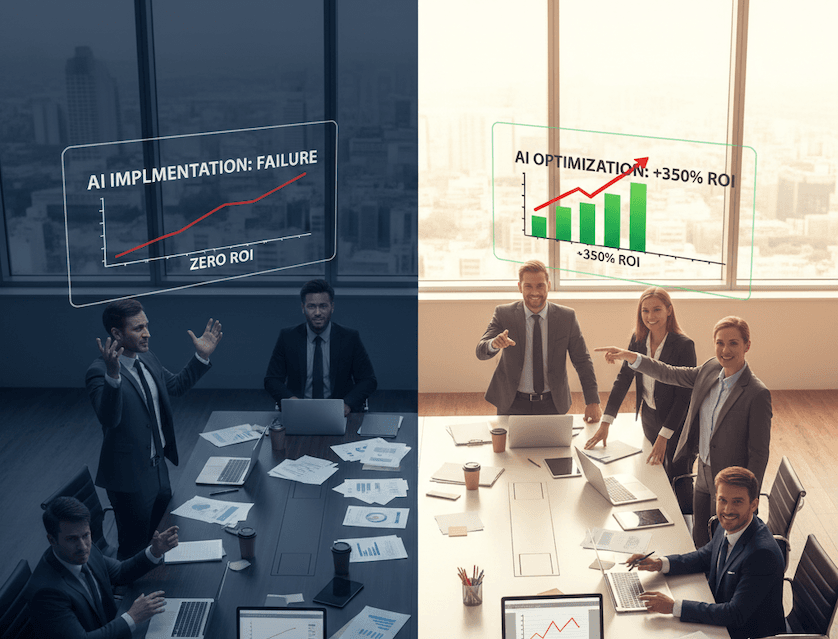
Here's what my last 30 days of conscious AI practice taught me: The quality of AI outcomes depends entirely on the consciousness you bring to AI deployment.
Unconscious AI implementation optimizes for efficiency without wisdom. It automates processes without considering stakeholder impact. It scales capability without scaling consciousness.
Conscious AI implementation starts with a different question: "How do we design this to serve all stakeholders' highest good?"
This isn't feel-good philosophy. It's a practical implementation methodology that prevents disasters.
The CONSCIOUS AI Framework Hassabis Needs
Hassabis provides a compelling vision. Conscious AI provides an implementation methodology. Here's how they connect:
Mindful Foundation
Don't start with "What can this AI do?" Start with "What should this AI do?" Consciousness assessment before capability deployment.
Conscious Capital
Build stakeholder value creation into your AI systems during development, not after. Distribution isn't a political afterthought—it's a design requirement.
Spiritual Intelligence
Integrate wisdom alongside capability scaling. Ask not just "Can we?" but "Should we?" and "How do we do this beautifully?"
Happiness Engineering
Optimize for human flourishing, not just operational efficiency. Measure stakeholder satisfaction alongside productivity metrics.
Sacred Integration
Daily practices that keep AI implementations aligned with organizational values and human consciousness evolution.
Why This Matters Right Now
If Hassabis is right about the 10-year timeline (and I believe he is), conscious AI implementation becomes urgent.
With 100x the speed of transformation, we can't afford to develop capabilities first and consciousness later. There won't be time to retrofit wisdom into systems already deployed at scale.
The Choice That Defines This Decade
Here's the hard truth: We're in the final years of pre-AGI civilization. The AI systems being designed today will be the foundation for Hassabis's "radical abundance" tomorrow.
Will those systems be designed consciously or unconsciously?
Will they serve human flourishing or extract from it?
Will they create genuine abundance for all stakeholders or concentrate power among the few who control the technology?
These aren't political questions for later. They're design decisions for now.
What Enterprise Leaders Must Do
Stop treating consciousness as a nice-to-have addition to your AI strategy. It's the difference between transformation and catastrophe.
Start with stakeholder impact assessment. Before you optimize for efficiency, ask: "How would this implementation change if we optimized for all stakeholders' well-being?"
Build distribution into development. Don't treat fair value creation as a post-deployment problem. Design it into your AI systems from day one.
Measure consciousness ROI. Track stakeholder satisfaction, values alignment, and long-term sustainability alongside efficiency metrics.
The AlphaFold Precedent Shows the Way
Ironically, Hassabis has already demonstrated conscious AI implementation. AlphaFold solved a decades-old scientific problem, then was released freely for global benefit rather than competitive advantage.
This is what conscious AI looks like at scale: breakthrough capability deployed for stakeholder flourishing.
The question is whether we can scale this consciousness approach as rapidly as we're scaling AI capabilities.
The Bottom Line
Hassabis's vision of abundance is achievable. His timeline is probably accurate. His approach to getting there is dangerously incomplete.
The organizations that bridge technical excellence with consciousness integration won't just survive the 10x AI revolution—they'll lead it.
The window for conscious AI leadership is closing as rapidly as the technology is advancing.
What choice will your organization make?
References:
Demis Hassabis interviews: Lex Fridman Podcast, 60 Minutes CBS, TIME100 2025
AlphaFold breakthrough analysis: Nobel Prize documentation, Nature publications
Enterprise implementation research: MIT, Stanford, Harvard studies on AI adoption
Personal practice data: 30-day conscious AI implementation + 25-year enterprise experience